
How Does Zoho Zia Compare to Salesforce Einstein?
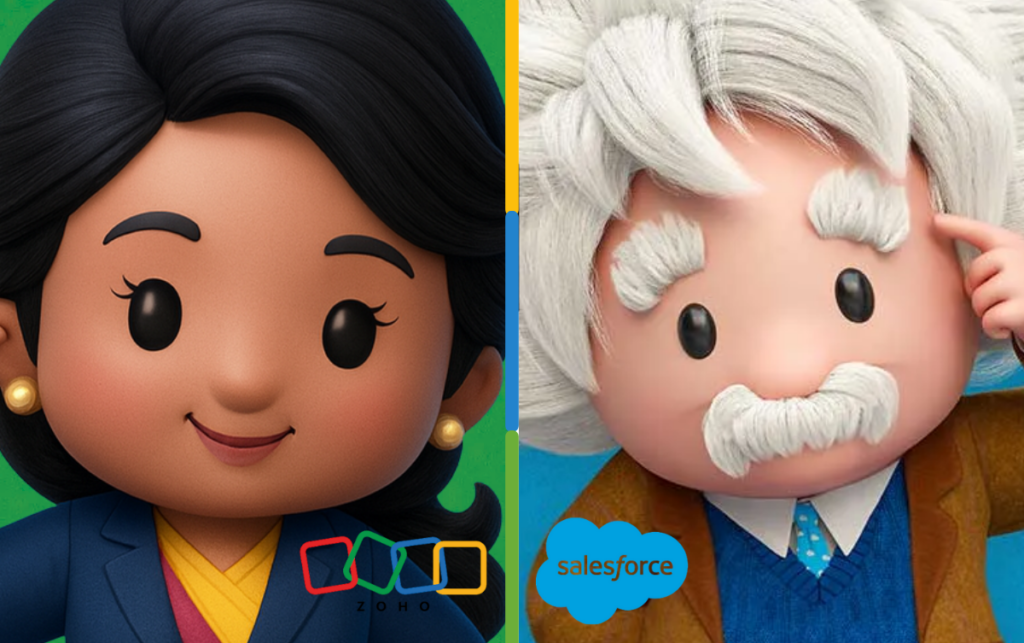
Recently, Salesforce acquired Informatica for $8 billion to address its AI problem.
Informatica is a data management company.
So, the reason why Salesforce is buying it?
Their shiny new AI brain, Agentforce, didn’t have the data infrastructure to make it work properly.
Which is like installing the foundations after building a house.
Now it might be easy to let it slide because Salesforce is Salesforce, and for some reason, they seem immune to criticism.
Except Salesforce raised prices by 6% at the beginning of August, proudly claiming “increased AI integration” as the reason.
Integrating what, exactly?
Marketing-ready AI or production-ready AI?
If CRM companies are serious about AI, they should stop duct-taping “AI-powered” labels onto half-baked features. Build products that work outside the demo room.
In this article, we’ll strip away the duct tape and see these AI tools for what they really are.
Marketing fluff or tools to enhance your business operations…
Let’s jump in!
What Is Zoho Zia?
Zia stands for Zoho Intelligent Assistant.
It’s deeply embedded into the Zoho ecosystem and trained on your actual business data.
Here’s what Zia can already do out of the box:
- Forecast sales and spot anomalies
- Flag deals that are going cold before your reps do
- Suggest the best time to contact a lead (based on engagement history)
- Automate repetitive tasks with natural-language prompts
- Summarise emails, tickets, and reports
- Interact via chat, voice, and email
And it does this without fanfare.
There are no extra modules, add-ons, or a need to call in a team of AI engineers.
What Is Salesforce Einstein?
Salesforce Einstein is a broader AI platform. It covers:
- Predictive lead scoring
- Opportunity insights
- AI-generated emails
- Einstein GPT (based on OpenAI)
- Even image recognition via Einstein Vision
But a lot of this only works if you pay extra, use specific Salesforce Clouds, or spend time custom-configuring your own AI models.
And that’s assuming your Salesforce instance is already well-structured and up to date (spoiler: many aren’t).
Quick Comparison: Zia vs Einstein
| Features | Zoho Zia | Salesforce Einstein |
|---|---|---|
| Sales Predictions | Built-in | Customisable |
| Deal Insights | Automatic | If configured |
| Workflow Automation | No-code & Native | Needs setup, Often Dev Support |
| Conversational Setup | Natural Language | With GPT Add-on |
| AI Email Drafting | In CRM, Desk, Campaigns | Via Einstein GPT |
| Cost | Included in CRM | Often Extra |
| Setup Time | Fast – 1-2 days | Medium – weeks |
| Data Prerequisites | Native Integration | Often Fagmented (hence Informatica) |
The Reality Check
Salesforce Einstein is the perfect AI tool for a keynote presentation. But in a live environment, many companies struggle to implement it beyond lead scoring.
Einstein assumes your data is perfect, your setup is airtight, and your budget is bottomless.
By contrast, Zoho Zia works with what you’ve got, and makes it better.
All it needs is a CRM that’s already designed for cross-functional intelligence — which, by design, Zoho CRM is.
FAQ
AI in CRM is only as good as the systems it supports. If the data is messy, the processes are half-baked, and the reporting is an afterthought, no AI can fix that.
At Caldere, we build the systems that make AI useful.
And we’ll continue choosing tools that actually work, even when the marketing is less flashy.
👉 Zia is practical, accessible, and production-ready.
👉 Einstein is powerful, expensive, and mostly enterprise-oriented.
If you’re a UK-based SME looking for intelligent automation and insights without hiring a data scientist, Zia is the clear winner.
If you’re a multinational with a Salesforce ops team and a budget to match, Einstein offers more depth.
Just be prepared to spend time and money getting it off the ground.
P.S. We can help you and your team learn how to use Zia as part of our Zoho training package. Message us if that’s something you’re interested in.
FAQ
What makes Zoho Zia different from Salesforce Einstein?
Zoho Zia is built into the Zoho ecosystem, making setup quick and easy. Salesforce Einstein requires add-ons, custom configurations, and extra costs. Zia works out-of-the-box, whereas Einstein thrives in enterprise environments with perfect data structures.
Does Salesforce Einstein require additional costs?
Yes, many Einstein features like Einstein GPT, image recognition, and advanced automation require extra modules or specific Salesforce Clouds. Zoho Zia, on the other hand, includes its AI features at no additional cost.
Which CRM AI tool is better for small and mid-sized businesses?
Zoho Zia is ideal for SMEs because it’s cost-effective, intuitive, and designed to work without heavy IT involvement. Salesforce Einstein is better suited for enterprises with large budgets and dedicated ops teams.
How quickly can Zoho Zia and Salesforce Einstein be implemented?
Zoho Zia typically takes 1–2 days to set up, thanks to its native integration within Zoho CRM. Salesforce Einstein usually requires weeks due to its customisation needs and data dependencies.
Zoho Zia is built into the Zoho ecosystem, making setup quick and easy. Salesforce Einstein requires add-ons, custom configurations, and extra costs. Zia works out-of-the-box, whereas Einstein thrives in enterprise environments with perfect data structures.
Yes, many Einstein features like Einstein GPT, image recognition, and advanced automation require extra modules or specific Salesforce Clouds. Zoho Zia, on the other hand, includes its AI features at no additional cost.
Zoho Zia is ideal for SMEs because it’s cost-effective, intuitive, and designed to work without heavy IT involvement. Salesforce Einstein is better suited for enterprises with large budgets and dedicated ops teams.
Zoho Zia typically takes 1–2 days to set up, thanks to its native integration within Zoho CRM. Salesforce Einstein usually requires weeks due to its customisation needs and data dependencies.