
Why CRM Is a Lifesaver in B2B, but a Weapon in B2C
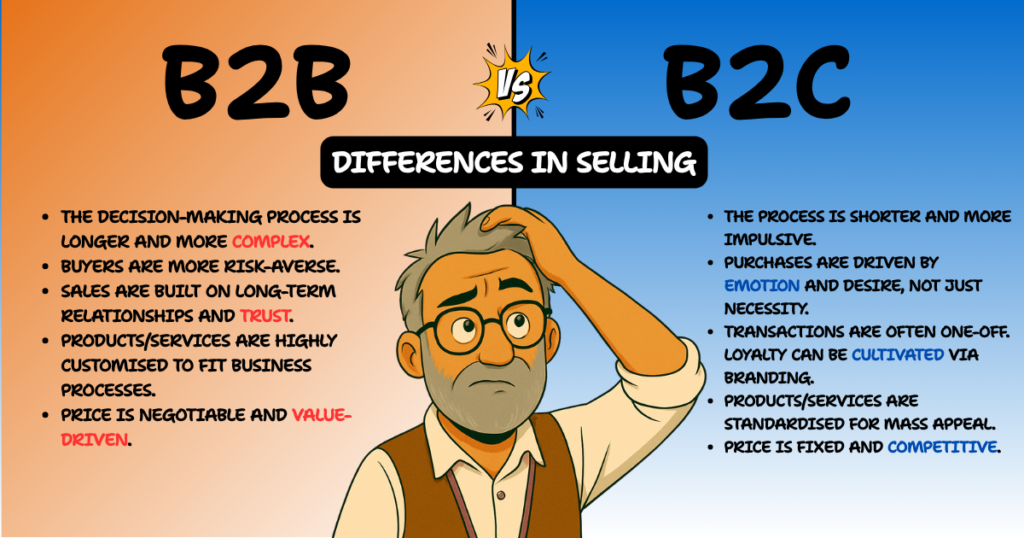
Did you know that in B2B CRM, the average buying committee is 6–10 people, and deals drag out for about 6–12 months?
But in B2C CRM, most “sales cycles” are under 24 hours, and often under 5 minutes.
Knowing the importance of CRM in B2B and B2C markets changes how you play the game.
If you’re running B2B sales, you’re not closing on charm alone, you’re navigating politics, multiple decision-makers, and a marathon buying cycle. Your CRM needs to track long-term touchpoints, stakeholder influence, and deal risk over months.
In B2C, it’s a sprint.
If your CRM doesn’t surface the right offer in seconds, you’ve lost the sale. Speed and automation matter more than relationship-mapping here.
At Caldere Associates, we’ve implemented CRM systems across industries, from finance to manufacturing, healthcare to education.
Here’s a dive into how our CRM implementation changes depending on the market types:
In B2B: CRM Holds Complexity Together
Bluestar was using an old CRM that couldn’t handle growth or remote work.
They had four cooks in the kitchen, all needing the same info but stuck with a clunky system:
Customer, supplier, lender, and the sales person.
Caldere moved them to Zoho CRM, custom-built for how they work. Two months later, COVID hit, and they were ready to work from anywhere.
If they’d stayed on the sinking ship that was ACT! CRM, their business would have been dead in the water.
Instead, they kept making deals because their CRM was built for reality, not theory.
They didn’t lose time or money scrambling to fix broken processes (sadly this was the case for many other businesses during COVID)
Their CRM actually matched how they worked, so deals kept moving even in chaos.
In B2C: CRM Wins Faster, Sells Smarter, Scales Sharper
We powered up the CRM of a B2C green energy provider, who had no visibility into its client lifecycle.
Their old setup was chaos. They had no idea when contracts were ending and no proper data. This meant deals slipped, customers left, and competitors got ahead.
Caldere gave them a fully mapped-out CRM that tracks every customer, measures performance, and spits out reports automatically.
So we built a 360° CRM with mapped journeys, defined KPIs, and automated reports.
Overnight, they stopped losing clients by accident and they were now able to spot problems early.
The CRM Divide: Lifesaver vs. Weapon
In both cases, there was a nuance to how we set up the CRMs. We’ve broken it down in this simple-to-read table:
| Benefit | B2B CRM (Lifesaver) | B2C CRM (Weapon) |
|---|---|---|
| Visibility | Across departments, deals, and lifecycles | Into customer behaviours and churn points |
| Access | Enables remote teams, centralises data | Scales campaigns, actions customer signals |
| Customisation | Reflects complex relationships and workflows | Drives personalised outreach at scale |
| Forecasting | Based on deep, cross-functional KPIs | Based on live customer trends |
| Impact | Prevents breakdown in operations | Enhances speed, targeting, and conversion |
Summary: CRM’s Role Depends on the Market Type
- In B2B, CRM is the lifesaver. It keeps multi-faceted operations afloat and integrated.
- In B2C, CRM is the weapon. It allows precision targeting, automation, and scalability.
No matter your market, CRM is the most strategic choice.
✅ Prevents internal failure in B2B environments
✅ Drives competitive advantage in B2C
✅ Aligns data, teams, and processes with goals
✅ Makes your business proactive, not reactive
Need your CRM to survive your next crisis, not collapse under it?
At Caldere, we don’t do cookie-cutter CRM installs. We custom-build survival systems.
If you want your business to keep operating in chaos…
If you want your sales process to keep breathing even when everything else flatlines…
If you want a CRM that actually fits how you work (not how the software company thinks you should)…
👉 Let’s talk.
Get in contact with us now and we’ll reply today with more info.
FAQ
What’s the difference between a B2B CRM strategy and a B2C CRM strategy?
B2B is account based, built for many stakeholders, long cycles, and careful pipeline control. B2C is audience based, built for speed, segmentation, and personalisation at scale.
How do CRMs help with long B2B sales cycles compared to instant B2C sales?
In B2B they map decision makers, log every touch, surface risks, and keep tasks moving for months. In B2C they trigger real time journeys, recommend offers, recover carts, and close in minutes.
Why is CRM seen as essential for B2B but just an automation tool for B2C?
In B2B the CRM is the operating system for revenue, without it deals stall and knowledge vanishes. In B2C people often treat it like a campaign launcher, though the best teams use it as the brain for data, targeting, and retention.
How do you customise CRM workflows for a B2B firm versus an online store?
For B2B build around accounts and opportunities with stage gates, approvals, stakeholder fields, playbooks, and handoffs to delivery. For B2C build around events like browse, add to basket, purchase, and renewal with segments, product feeds, vouchers, returns flows, and constant A B testing.
B2B is account based, built for many stakeholders, long cycles, and careful pipeline control. B2C is audience based, built for speed, segmentation, and personalisation at scale.
In B2B they map decision makers, log every touch, surface risks, and keep tasks moving for months. In B2C they trigger real time journeys, recommend offers, recover carts, and close in minutes.
In B2B the CRM is the operating system for revenue, without it deals stall and knowledge vanishes. In B2C people often treat it like a campaign launcher, though the best teams use it as the brain for data, targeting, and retention.
For B2B build around accounts and opportunities with stage gates, approvals, stakeholder fields, playbooks, and handoffs to delivery. For B2C build around events like browse, add to basket, purchase, and renewal with segments, product feeds, vouchers, returns flows, and constant A B testing.