
6 CRM Mistakes UK Law Firms Make (and How to Fix Them)
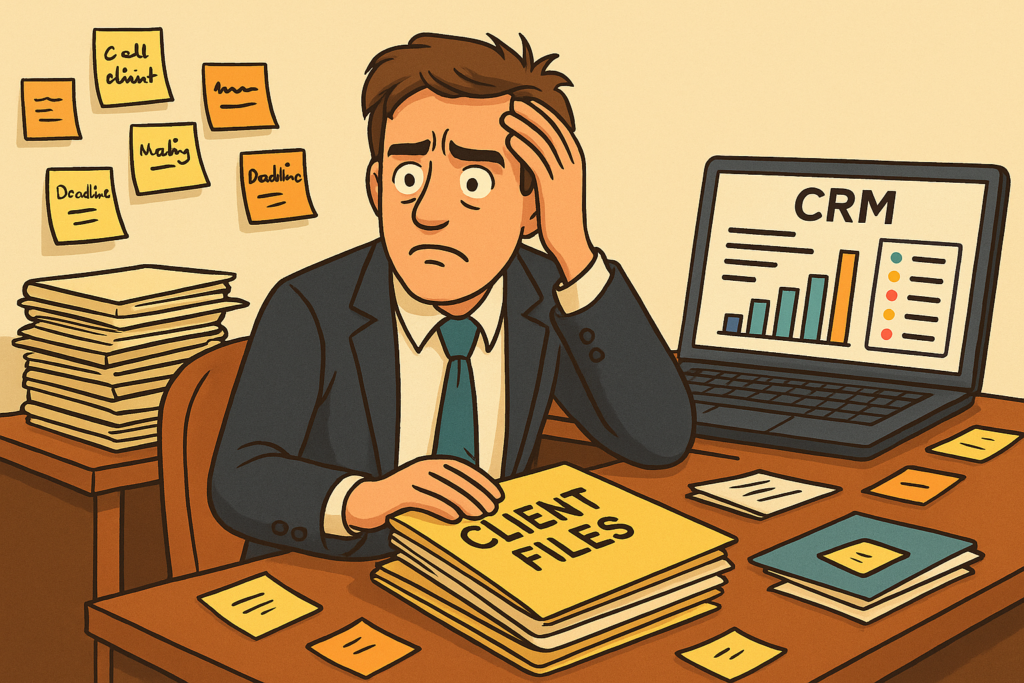
A London solicitors’ firm rolled out a new CRM. Three months on, half the fee-earners barely logged into it.
Then, a long-standing client was miffed when two different partners unknowingly pitched them the same update.
This is a common issue in the UK; nearly 70% of CRM projects fail to meet expectations.
And often, it’s not the technology to blame but how firms use it.
Eventually, this law firm reached out to us and we helped them get their CRM set up the right way.
With that said, let’s shine a light on six common law firm CRM mistakes and, crucially, how to fix them so it can pay its dividends.
Table of Contents
Dictionary
CRM – Client Relationship Management
A system that helps law firms manage client contact details, communications, and business development activity in one place.
KPI – Key Performance Indicator
A measurable value that shows how effectively a firm is achieving specific goals, like client response time or new matter conversion rate.
A system that helps law firms manage client contact details, communications, and business development activity in one place.
A measurable value that shows how effectively a firm is achieving specific goals, like client response time or new matter conversion rate.
Mistake 1: No Clear CRM Strategy or Leadership Buy-In
Law firm CRM mistakes often begin before the software is even switched on.
One of the biggest missteps is diving into a new CRM without a clear strategy or senior buy-in.
Maybe a firm hears that a CRM for law firms is essential, so they purchase a shiny new system and assume success will magically follow.
There’s no defined business goal, no champion at the partner level, and no plan to drive user engagement.
Naturally, the CRM becomes an expensive digital Rolodex that nobody truly owns or optimises.
So, when leadership doesn’t actively support the project, solicitors see the CRM as just another IT initiative rather than an actual game-changer for client relationships.
Without a strategy, the system might be configured poorly or not aligned to the firm’s workflows. It’s a recipe for low adoption and quick abandonment.
How to fix it: Treat your CRM initiative like any major client matter – start with a plan.
Define what you want to achieve (e.g. improve client follow-ups, track referrals, increase cross-selling).
Secure a partner-level sponsor who believes in the CRM’s value and can rally others.
Set KPIs (like increasing client touchpoints or response times) and express the CRM adoption benefits to the team (e.g. “This will help you close deals faster and manage relationships in one place”).
When everyone understands the why and leaders lead by example (yes, partners should log in and use it too), the CRM stops being just a tech toy and becomes a strategic tool.
Mistake 2: Treating CRM as One-Size-Fits-All
Another common law firm CRM mistake is treating the system like a plug-and-play address book, without tailoring it to the legal profession.
Law practices have unique needs, from tracking matters and referrers to managing long-term client relationships. Yet some firms try to shoehorn their processes into a generic CRM template.
The result is a clunky setup that doesn’t fit how solicitors work.
Important fields (like conflict check status or matter type) might be missing, while irrelevant ones clutter the interface.
Users get frustrated and stop entering data. And as such, this poorly fitted system ends up underused.
Think about it: a corporate sales CRM out-of-the-box might track “deals” and “products,” but a legal CRM should track clients, matters or cases, key dates (court dates, contract renewals), and relationships between contacts (clients, barristers, opposing counsel, etc.).
If your CRM isn’t capturing the information that matters to a law firm, lawyers will rightly question its usefulness.
How to fix it: Customise and configure.
If you’ve invested in a CRM designed for law firms, take the time to mould it to your firm’s workflows.
Create custom fields and modules that reflect how you manage clients and matters.
For example, set up categories for practice areas, link contacts to specific cases or deal teams, and configure reminders for key legal deadlines.
Many modern CRM platforms (or specialised legal CRM systems) allow extensive customisation – use that power to make the tool speak your language.
If needed, work with a CRM consultant (like Caldere) who understands legal industry nuances.
A tailored system will feel intuitive to your team, which means they’re far more likely to use it daily.
Mistake 3: Letting Data Get Dirty and Disorganised
A subtle law firm CRM mistake that can quietly sabotage your CRM is poor data hygiene.
Over time, as contacts get added and updated (or not updated!), your once-clean database can turn into a mess of duplicate entries, outdated info, and missing details.
Imagine searching your CRM for a client’s address and finding five different entries for the same client. One with an old office location, one with a typo in the name, others with partial data.
It’s frustrating, and it erodes trust in the system.
Attorneys might start keeping private records again “just to be sure,” defeating the whole purpose of a centralised CRM.
Bad data directly impacts client service. If a solicitor prepares a briefing note with the wrong spelling of a client’s name or misses an important contact because it wasn’t marked as linked to a matter, the impression left is hardly professional.
Also, marketing efforts suffer when email lists include outdated or incorrect addresses.
So, to review, even the best legal CRM is only as good as the data inside it.
How to fix it: Institute a data hygiene regimen.
Establish clear guidelines for data entry (e.g. standard formats for names, addresses, matter names).
Leverage the CRM’s tools for de-duplication and data validation; many systems can automatically flag duplicates or incomplete records.
Consider assigning a data steward or making someone (perhaps that tech-savvy trainee or the practice manager) responsible for periodic data clean-up.
Also, train your team on the importance of keeping information up-to-date.
When everyone understands that maintaining quality data is part of their professional responsibility, the CRM remains a reliable source of truth.
Some firms even integrate client intake software that feeds information directly into the CRM, reducing manual entry errors.
So a clean database means lawyers can trust the CRM and rely on it, which in turn boosts usage.
Mistake 4: Neglecting the Client Intake Process
One of the more visible law firm CRM mistakes is failing to integrate new client intake and lead follow-up into the CRM workflow.
It’s surprising how many firms spend money on marketing to drive enquiries…only to drop the ball when those enquiries actually come in.
When a potential client calls or fills out a web form, where does that information go?
In some firms, it languishes in someone’s email inbox or a notebook, separate from the CRM.
Without a systematised intake process, opportunities fall through the cracks.
In fact, a recent study of 1,300 law firms found that nearly 27% of online enquiries went unanswered – a shocking statistic that points to lost business and poor client experience.
If your CRM isn’t part of your prospective client pipeline, you’re likely missing out on revenue.
Lawyers are busy with existing cases and may not have a “sales” mindset to chase every new lead, but that’s exactly where a CRM shines.
Neglecting to log enquiries or track follow-ups means your firm is essentially leaving money on the table and potentially earning a reputation for unresponsiveness.
How to fix it: Make client intake a core part of your CRM process.
Use client intake software or CRM web-to-lead forms to capture every new enquiry directly into the CRM, whether it’s a phone call, website form, or referral.
Set up automated alerts or tasks so that when a new potential client comes in, someone is assigned to follow up within hours, not days.
You might integrate your website contact form with the CRM, so no enquiry slips by unnoticed.
Develop a simple intake workflow: for example, log the enquiry, assign it to a solicitor or team, schedule a follow-up call, and track the outcome (consult scheduled, not a fit, etc.).
By treating each lead with the same care as you would a key client (and by letting the CRM system prompt and record those touchpoints), you ensure no prospective client falls through the cracks ever again.
This is exactly how you start client relationships on the right foot.
Mistake 5: Dropping the Ball on Onboarding New Clients
Some law firm CRM mistakes happen right after you’ve won the client.
The hard work of converting a prospect is done, but now comes the onboarding phase: conflict checks, engagement letters, gathering key client data, introducing the team, and so on.
Many firms handle these steps ad hoc via emails and spreadsheets, disconnected from the CRM.
The danger is that important onboarding tasks might be missed and valuable client information remains siloed.
If a new client’s preferences or important dates (like a commercial client’s fiscal year-end or a private client’s birthday) aren’t captured in the CRM at the start, you lose opportunities to personalise service later.
And if the onboarding experience is disjointed or slow, clients might second-guess their choice of firm.
Remember, the client’s experience in their first few weeks sets the tone for your relationship.
A streamlined, attentive onboarding builds confidence.
A chaotic one e.g. “Oh, sorry we missed sending that document; could you fill out this info one more time?” will erode trust.
How to fix it: Create a formal onboarding checklist and integrate it with your CRM.
Many CRM systems or linked client onboarding software can automate onboarding workflows.
For example, once a new matter is opened or a client is marked as “Active” in the CRM, it can trigger tasks: verify conflict check completion, send a welcome packet, schedule a kickoff meeting, and collect any remaining client data.
Ensure that all the data gathered during onboarding (client contact details, key stakeholders, preferred communication methods, relevant dates) goes into the CRM immediately.
You can even use the CRM to set a reminder a month into the engagement to ask the client how things are going.
By using the CRM to orchestrate and record the onboarding steps, your team provides a consistent, high-quality experience.
That way, you set up your CRM with rich information to deepen the relationship going forward.
Mistake 6: Forgetting the Human Element – Training and Ongoing Use
Finally, a major law firm CRM mistake is thinking the implementation is “done” once the software is live, without nurturing ongoing use. Lawyers and support staff won’t automatically embrace a new system just because it’s there.
In fact, many CRM initiatives falter due to lack of proper training, support, and culture change.
The software might technically work, but if people don’t use it, it’s as good as dead.
We’ve seen firms where logins dwindle after the first month, or where only the marketing team updates contacts while fee earners ignore it.
The irony is that the success of a CRM in a law firm is largely measured by attorney participation – yet attorneys are often the ones most resistant to using it.
No one likes extra admin work, and if busy solicitors perceive entering data into the CRM as a chore with no immediate benefit, they will sidestep it.
That’s why focusing on the human side of CRM is so critical.
Failing to provide hands-on training and CRM adoption initiatives (like refreshers, tips, and even incentives) is a mistake that can sink your investment.
How to fix it: Prioritise the people factor. Conduct engaging training sessions that show, not just how to use the CRM, but why – use real law-firm scenarios (e.g. “Here’s how to use the CRM to quickly pull up all clients in the retail sector for a targeted update”).
Offer continuing support: quick cheat sheets, a helpdesk for CRM questions, and periodic workshops to showcase new features or best practices.
Encourage a culture of using the CRM by celebrating wins (“Thanks to the CRM, we noticed Sarah hadn’t been contacted in a year and rekindled the relationship!”).
CRM adoption isn’t a one-time event but an ongoing effort…and it’s worth it.
When your team fully embraces the CRM, clients notice the difference in attentiveness and no details slip through.
In the end, technology should serve people, so it makes sense to invest in your people to get the most out of the technology.
The Payoff: Better Relationships and Efficiency
Getting CRM right is a journey, but the results are well worth it.
UK law firms that avoid these common CRM mistakes see tangible benefits, like stronger client loyalty and streamlined operations.
In fact, 84% of law firms say that using legal CRM software has increased efficiency in their organisation.
So with that said, here’s a bold claim:
When law firms fail, it’s not because they’re bad at law. It’s because their CRM is a mess.
At Caldere, we know this to be true because we’ve spent decades fixing CRM disasters for UK firms; rescuing projects on life support and turning them into client magnets.
So if you’re sick of wasting money and watching opportunities slip through the cracks, it’s time we talked.
Chat with us now and we’ll get you all the info you need to get you on the right track to building an efficient and powerful CRM for your law firm.
– Caldere Team
FAQ
What is the biggest problem facing law firms?
Many law firms struggle with inconsistent client communication and poor data management. Without a proper legal CRM, it’s easy to miss follow-ups, lose leads, or duplicate work, especially across busy teams.
Do law firms use CRM?
Yes, more firms are adopting CRM for law firms to streamline client relationships and automate admin tasks. Tools like Zoho CRM help solicitors stay organised and improve service without increasing workload.
Can a law firm sue its own client?
Yes, but it’s rare and often risky. Disputes usually involve unpaid fees. Having a client onboarding software and clear engagement terms logged in your CRM helps reduce misunderstandings from the start.
What does CRM stand for in law?
CRM stands for Client Relationship Management–a system to manage contacts, client history, intake, and follow-ups. A solid CRM adoption strategy ensures better retention and business growth for solicitors.
What is the best CRM for a legal firm?
Many recommend Zoho CRM for UK law firms due to its flexibility, cost-effectiveness, and easy integration with client intake software. It’s ideal for firms that want custom workflows without paying through the nose.
Many law firms struggle with inconsistent client communication and poor data management. Without a proper legal CRM, it’s easy to miss follow-ups, lose leads, or duplicate work, especially across busy teams.
Yes, more firms are adopting CRM for law firms to streamline client relationships and automate admin tasks. Tools like Zoho CRM help solicitors stay organised and improve service without increasing workload.
Yes, but it’s rare and often risky. Disputes usually involve unpaid fees. Having a client onboarding software and clear engagement terms logged in your CRM helps reduce misunderstandings from the start.
CRM stands for Client Relationship Management–a system to manage contacts, client history, intake, and follow-ups. A solid CRM adoption strategy ensures better retention and business growth for solicitors.
Many recommend Zoho CRM for UK law firms due to its flexibility, cost-effectiveness, and easy integration with client intake software. It’s ideal for firms that want custom workflows without paying through the nose.